


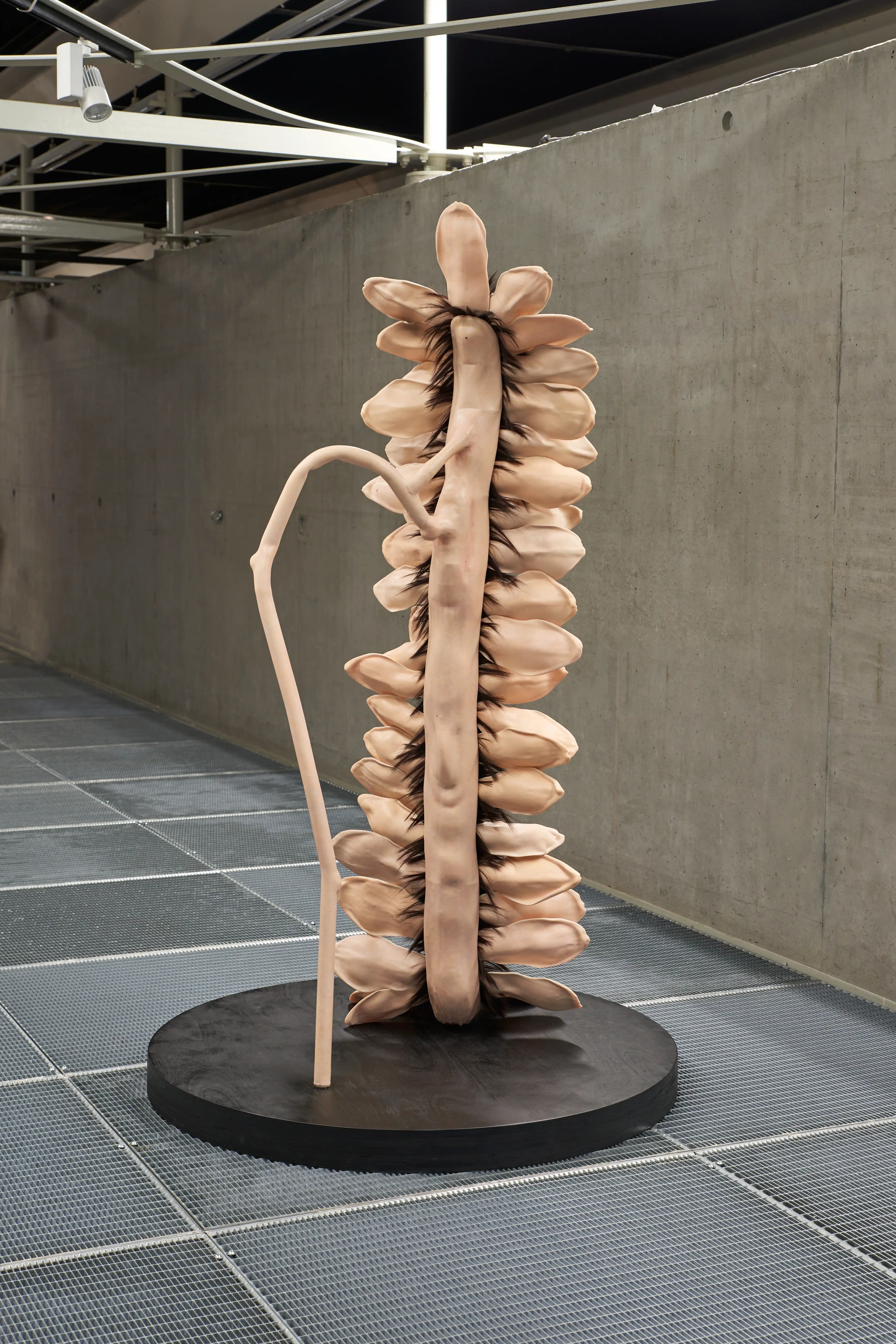
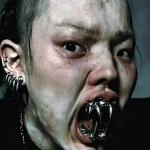
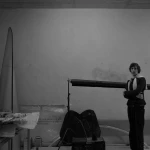
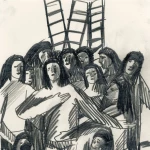

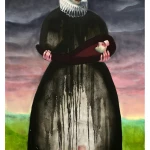
Nicolas Winding Refn tells us about the filming of Touch of Crude, in which his wife and children play the leading roles. He says the end of the shoot was like the end of an odyssey, and of my own life. He says he had died and been brought back to life. Whether he means a physical death or a metaphorical one remains unclear. At fifty-two, this kind of rebirth has given him the opportunity to return to the youthful recklessness of his twenty-four-year-old self.
Later that evening, we climb the spiral staircase back up to the restaurant’s main dining room. His wife, Liv Corfixen, is waiting for him for dinner. He introduces her to us with the words: She is the daughter of Fritz Lang. Her mother, he tells us, had apparently been a beautiful model in the United States and had met the German director twice. Since Fritz Lang was said to have had a preference for young women, and Liv resembled him, he had developed the fantasy of being married to Fritz Lang’s daughter. Back in my hotel room, I still wonder: Had he really died? I write to his team, and one of his daughters replies: Nicolas underwent heart surgery after being diagnosed with a leaking heart over two years ago. He was ‘dead’ for several minutes during the surgery but emerged healthy and strong.
JULIUS SEBASTIAN FÜHR: I was wondering if you ever bought the Kenneth Anger Lucifer Rising bomber jacket that circulated on the internet?
NICOLAS WINDING REFN: Oh yeah! I don’t have it, but I know of it. I’ve seen it over the years. A lot of the iconography from Kenneth Anger’s work is very good for fashion. I stole the Scorpion logo from Scorpio Rising to put on the back of the jacket in Drive. So you can say it came from Kenneth Anger.
JSF: Did Kenneth Anger ever get a copy of the jacket from Drive?
NWR: Sadly not. I met him once many years ago. But he became very fragile and he wasn’t really seeing people. And when I tried to meet him again he had sadly passed away.
JSF: He’s been a big inspiration for you.
NWR: Kenneth Anger has been an inspiration for many people. So I’m just one in a cloud of people. I think in the beginning it wasn’t really my thing. I was in another place. Suddenly when I began to approach filmmaking in a more fetishized way, he must have imprinted himself without me knowing it.
JSF: In the conversation you two had at the Copenhagen Museum of Fine Arts he mentioned that all artists are magpies – everyone steals. It seems that in filmmaking it is not offensive to steal from fellow filmmakers while in other art forms nowadays the works are protected and copyrighted preventing artistic theft.
NWR: Any art form is just there to be taken advantage of. You know, art is not sacred. And I think that for me you take what you like – you just have to make it your own. So it’s the difference between stealing and duplicating. And if you steal you’re actually doing a service to yourself because you’re obviously affected by something that you want to continue to investigate. If you duplicate it you’re just copying it, which is different.
JSF: I mean in different Asian cultures copying an artist or duplicating a masterpiece is considered the highest form of art.
LEIF ARNE ASMUS: I recently came across an idea by Byung-Chul Han in his book Shanzhai: Deconstruction in Chinese. He suggests that a copy can in some ways have an advantage over the original. Because it comes later the copy already knows what the final work looks like and can refine adjust and even improve upon it. In that sense the copy can become closer to an ideal version of the work than the original itself almost to the point where it begins to function as a new kind of original.
NWR: With the invention of the digital age everything is just deconstructed. What you’re clinging to is something that doesn’t have any right to exist. Because what you end up creating is essentially no longer yours. As much as you claim that this is your work it is your work the minute you finish it but after that it’s everyone else’s opinion. And I don’t find anything sacred in that form of protectionism.
JSF: Let’s talk about this omnipresent topic AI.
NWR: AI is fantastic. In terms of creativity it’s an amazing tool that has not yet been fully developed. From a social infrastructure perspective it’s very dangerous. It isn’t a good thing that inequality continues to grow financially because of technology. I don’t want to live in a world where inequality is so dangerous. I’m sometimes amazed that people are not more conscious of history of understanding that if we don’t share each other’s lives at a certain point life becomes pretty unbearable. So for me AI is many different things. And I also believe that the philosophy of AI is still at such an infant stage that in the end no one really knows what they’re talking about.
JSF: You tried using ChatGPT for your new film Her Private Hell but it proved utterly useless.
NWR: It was programmed to give answers to questions that I didn’t share opinions with. So it was trying to steer me in a narrative direction that was what you would call acceptable in terms of society’s view on a story. But I don’t find that critically satisfying.
JSF: How were you trying to integrate ChatGPT? In the development of the story?
NWR: Not even that. I just asked it the most extreme questions you could ask to see how it would respond. And it had no human understanding of it. It would basically guide you to a web page to seek information about whatever trauma you presented to it.
JSF: Trauma?
NWR: Yes, creativity is very much about trauma or at least understanding how to turn your weaknesses into strength or into stories and experiences about pain, failure, love, and success. I was interested in seeing the level of trauma ChatGPT could handle. I tried talking to it but it was incredibly annoying so I stopped. I haven’t spoken to it since.
JSF: To what extent do you believe AI will play a role in the future of filmmaking?
NWR: It already plays a big role. It depends on what you’re doing. I’m doing my first AI experiment, in terms of the AI style and the idea of using AI to create images, actors and storylines. I love what I’m seeing. Again for me as a creator it’s just a tool. I’m giving it paint and a brush and a screen. Now what can I do with it? It’s exciting. But obviously it affects an ecosystem especially in mass media which is financially very challenging. And that obviously makes you think what does that do to society?
JSF: Let’s talk about genre, horror and fantasy.
NWR: I like genre because genre is fantasy. And I like fantasy. The imagination extends time and space. It gives you as a creator a much more fulfilling canvas to explore whether you’re working in: painting, music, movies or writing. Anything that is heightened I find interesting.
JSF: Are the rumors true that your new film Her Private Hell will be coming to cinemas soon?
NWR: Well I have to finish it first. I just came back from Rome where we are mixing the music for the film.
JSF: A few years ago you mentioned that The Texas Chain Saw Massacre was an epiphany for you and made you want to become a filmmaker. What made you think this is what I want to do?
NWR: We all go through certain times in our youth when we’re exposed to the right experience that leads us to pursue what we later become. I was just 14. I went to see The Texas Chain Saw Massacre at the Cinema Village, an old cinema located in Manhattan, New York, which is still around. When I saw that movie it was the first time that I saw a film as an art form, a film as a painting, a film as experimental sound, a film that didn’t have the conventional sense of narrative, a film that was a combination of fairy tales and absurd humor. Earlier I had been exposed to film as a commercial medium. It’s like all the bands going to see the Sex Pistols or the Ramones and going: whatever that is, I’m going to make it. And then a thousand bands would recreate them. It’s hard to say what it was. It wasn’t that I wanted to do what I saw, I wanted to do what it made me feel.
JSF: You are proud of not having gone to film school however your father Anders Refn initially thought it was almost insane to try making a film without formal training. What gave you that confidence back in 1996 to film Pusher?
NWR: I was 19 when I was kicked out of acting school in New York. I came back to Denmark without any future opportunities let alone did I have any real talent. Both of my parents worked in film. Me and my friends would use their equipment and start making films at home. Also every summer I worked as a film scout for my uncle for two or three years. My job was to scout the market for films like going to the Cannes Film Festival. That exposed me to the idea of film as a commodity how do you buy and sell a movie. And then I got into film school. At the same time I had been in Cannes and I had decided I was going to make a movie now. It had to be something with crime because that was selling the best. But of course, I’ve always loved the idea of crime as a kind of anti-hero. A lot of other film directors had begun their careers in the crime genre. So I thought why don’t I do that. As a young man this exposure to that form of masculinity in the crime genre seems very fascinating. Initially Pusher was made at home and as a short film but then I got into film school.
At the same time God had a plan he was able to persuade the Danish government to give me 700,000 dollars in grants to make my first film. Suddenly I got money from the government and was able to make the first film by pure luck, it will never happen again. So then I dropped out of film school before even beginning. I was supposed to start after the summer and that’s when we began shooting the film.
JSF: So one could say you made your first film by the favorable and fortunate circumstances of your parents house and faith?
NWR: I would say, I made my first film with the arrogance of youth. I didn’t know how to make a movie. I’d obviously been exposed to movies because of my family and so forth over many years. I never had any interest in making movies necessarily but I was given this opportunity. I went all in and as they say, I did it my way.
JSF: You’ve said fuck film school in the past. Do you still feel that way today or did you ever regret not going in the end?
NWR: I thank God every day for making the decision to drop out of film school so by no means. Obviously being inspired or being taught a technique especially if you are in a mechanical department is always good. Film school or university in general isn’t necessarily bad but when I began it was certainly not the only way for me. Being educated to create is a bit absurd because we should spend more time talking about why we’re creating. However we spend most of our time discussing the act of creation and what it means or how it fits into society. I have very little patience for those kinds of debates. I like the idea that the act of creativity is something inside of you that needs to be exposed and your task is to find your canvas. And with the progress of technology and AI social media or gaming they all add a new layer of opportunities. And that’s exactly where it becomes interesting. There is no right or wrong. When I was young I was arrogant and rebellious. I was against the system that I felt was pigeonholing an ecosystem which was no longer relevant. Obviously I would have been the first to throw a stone at the glass house. But that’s what you do when you’re young and then you become wiser you start having a wife and kids and you suddenly start to realize you have much bigger headaches.
JSF: Did being dyslexic have any influence on you as a filmmaker? How did that change the way you were thinking?
NWR: Well, dyslexia is a very uncomfortable thing to have, especially when you’re young and you’re in school. There, you’re certainly not welcomed into the educational community, and nobody wants to have any assignments connected with you because you can’t fulfill them. There are various degrees of dyslexia, and mine is severe. At the same time, being dyslexic is also a gift because most people, out of necessity, live their lives very much like a straight line. But when you’re forced to compensate because of your inability to function within that straight line of normalcy, you can develop muscles in your brain, or in your psyche, that are exercised in ways other people’s are not.
Most people live in what I call comfortable pain throughout their existence. But because I’m diagnosed with what is called high sensitivity, among other things, I have excess behavior. I don’t have a filter, I don’t have a barrier in what I want to experience, I don’t have a limitation. I would be the worst junkie in the world; I would die within a day. As an example, I consider myself as much a writer as any other writer; I just don’t have the ability to type. My brain won’t talk to my hand. So I work with people that I can dictate everything to, and they write it out. I’m also colorblind. Sometimes when I work with a technical crew and they tell me, Oh, you’re colorblind, that’s too bad, I wish you could see this, then I say, No, no, no, it’s the other way around. We have to make it so I can see it. When we do it this way, then it becomes how I see the world, and that is my individualism. No one can copy that. So again, you become your own, and that weakness became my superpower, something no one else had.
LAA: You shoot chronologically, so the film develops while you’re making it. You don’t know the ending in the beginning, which means you don’t work within a straight line. Does that come from your way of thinking, from the nonconforming strategies you’ve developed?
NWR: I like not knowing and seeing what it can become. At some point the film will show itself.
JSF: So you force yourself into this liminal space of not knowing.
NWR: Yeah, it’s this idea of where the story is moving towards. I can change direction or come up with new ideas as we film. And essentially, like with everything, one day I just run out of money and have to finish it.
JSF: I saw Beauty is Not a Sin, and I thought: are you religious or do you believe in God?
NWR: I was not brought up in a religious household. But I think everyone ultimately arrives at the question of purpose and religion in a way provides an answer to that. Everyone at various stages of their lives becomes religious.
JSF: Speaking of gods, you’ve worked with the fashion goddess herself – Miuccia Prada. With Touch of Crude in 2022 did Mrs. Prada reach out to you?
NWR: I was approached by Mrs. Prada and Raf Simons to meet about doing a fashion show for them in Milan. But then that idea multiplied, and we ended up doing other things, like an invitation that was like an installation, like a mini experience. The show itself was terrific. I ended up doing a movie. That was a very interesting experience for me because it was the first time that I had complete freedom, because I didn’t have to make something that had the burden of a commercial medium or commercial success. I didn’t have to make money, and when you don’t have to make money, it’s like a whole breadth of new frontiers. I could further develop and explore this initial idea we had at the beginning. That was a very pivotal moment in my life, where I realized that I’m no longer excited by one experience. I want to turn one experience into multiple experiences.
JSF: Touch of Crude had a bit of Carl Theodor Dreyer’s The Passion of Joan of Arc and of course Kenneth Anger’s Inauguration of the Pleasure Dome came to my mind.
NWR: They are all in there. The idea that Raf Simons and Mrs. Prada needed for the show was what I called domestic voyeurism. The idea that you’re inside your own house, but you’re still a voyeur within it. I was able to record this because I obviously like the art of visual experience. I was able to build this show space, which then became an installation in itself. I found the idea of a ghost story very interesting. So we took a house that we found in Milan and turned it into three different stages of three different women. And they’re all, in one way, connected to a sense of the supernatural. It all leads to “the box”, which is the alien that arrived. But the alien is essentially the best friend of Mrs. Prada, which my youngest daughter then portrayed. They are, in a way, the founders of everything.
JSF: How was it filming with your family? Was that a new dynamic?
NWR: It was great. We were living in a great city, with some of the best restaurants. On the last day of filming, we celebrated my birthday. It was very … it was kind of the end of the road in many ways, because I had already shot Copenhagen Cowboy for Netflix. So I didn’t have anything left in me to do, at least I didn’t have any desire. And I don’t approach filmmaking as a mechanical component. I don’t have that ability to just make something purely for the sake of making it. So in a way, it was also the end of an odyssey, and of my own life. This is what it all came down to. I had to regain it. It took a number of years to re-examine what it is that I wanted to do. In this period I had died, I was dead for half an hour and then brought back to life. So there was a kind of religious transformation in being able to work and make Touch of Crude with Mrs. Prada, and then coming to the end of my life. Dying, literally, and suddenly being brought back. In a way, I’ve been given a gift. I was brought back at an age where I was still physically and mentally strong enough to start over again. And I had to relearn basic ideas of movement. My brain had been reset. In order to now begin again, to create with this arrogance of youth that I had when I was 24. But I was 52, and I think that this was an opportunity that changed my life. And that obviously led to wanting to make a movie again. Then we revisited Her Private Hell. As well as this idea of creating other formats that I had not done before, like doing the exhibition Satellites in Tokyo with Prada and my friend Hideo Kojima, about this idea of loneliness and failure as a person, as a father, and as an artist. All those things became much more important, and it made me more interested in other things.
JSF: Tarkovsky’s writings in his book Sculpting in Time describe this idea of the poetic film, the film being a medium in itself. Because of course film is an interdisciplinary art form; many departments work together. But as a filmmaker one has to separate oneself from this interdisciplinary thinking and think of it just like a painter thinks of paint on canvas, as a poetic nature itself.
NWR: That’s pretty smart.
JSF: Yes, he saw the role of the artist as a kind of obligation to search for a more abstract truth, to confront the human condition, even at the cost of personal sacrifice. He even called his last film, which was dedicated to his son, The Sacrifice. To what extent can you relate to the idea of filmmaking as a search for truth, and how much personal sacrifice does one go through as a filmmaker?
NWR: For me, the search for truth is tricky because I don’t know what the truth is. It sounds great, I just don’t know what’s true or not. But I of course understand the concept, this idea of finding something in its purest form, which Tarkovsky obviously was able to do, the transcendence of the experience from a physical to an emotional and religious payoff. It makes complete sense, and yes, I know from experience that due to the weight I carry in this creative process, filmmaking is incredibly rewarding, but at the same time it is also very tiring, physically and mentally. There is a sacrifice in that process.
Tarkovsky lived under a different political system, which was even more romanticized in its sacrifice. I live in Copenhagen. It’s not like we don’t have any problems, but the idea of going all the way regardless of what anyone else thinks or does is a form of sacrifice. It’s like going into a casino with only one chip and placing it on one number, and there will be no other opportunities. One single chance. So it’s a mega risk, failure or success. For me, this notion of doing it all the way or doing it your way is essentially a form of gamble, because there’s no safety. That is essentially the search for truth, because the truth exists in being one hundred percent yourself.
JSF: This notion is something very intrinsically human and fundamental to our condition, not to be mistaken with an agenda, ideology or dogma.
NWR: Yes, because I’m not a politician. I don’t have an agenda. I’m not here to give a message. In the media, everyone is obsessed with opinions. Where do you stand politically? What’s your thought on this? Why is your movie, or show, or painting not reflecting that? It almost degrades the experience, turning it into information. Which side are you on, in a very unnuanced discussion about anything. That’s incredibly annoying, because it becomes more about people’s own self-gratification of the ego, of them having challenged, understood, and accepted. So there’s too much reflection on words. Art is less reflective, at least as I see it. My approach to anything I do is more about creating an experience that doesn’t have an ideology. It’s just the pure essence of experience.
JSF: In an age where everything can be shown or said, what do you think truly provokes today?
NWR: Over the years, since the commercialization of creativity, there have been taboos, things you couldn’t or weren’t allowed to show or do because of religious control, financial control, industry control, morality, or public outrage. But over time, those barriers began to break down, the floodgates opened, and then, a few years later, you suddenly could. Today, there is almost nothing you can’t show or say anymore. So what really provokes the psyche? Because the psyche, in order to be experienced, has to be broken down. We have so many guardrails on our existence that we end up rejecting the experience itself. We’ve become obsessed with the information around it, the process of it, the consumption of it.
We are constantly bombarded with information and experiences, most of which have zero calories, they’re just dopamine. In a way, the most provocative thing you can do today comes down to two very simple actions: make it slow and make it silent. And it’s fascinating that this is where we’ve arrived, that slowness and silence have become the most provocative gestures. It’s ironic, because those are the very principles that create a healthy mind and a healthy soul. So I’m actually very excited about the future, because it feels like we’re finally getting somewhere.
JSF: In The Testament of Orpheus, Jean Cocteau’s last film, he explores this idea of not knowing, and that not knowing is the essential and ideal state of the poet. He plays himself as a poet, favoring artistic intuition, dreams, and mystery over rational understanding.
And he presents the artist as someone who embraces the unconscious, creating a kind of machine of meaning, the idea that metaphor is smarter than the author. You can think so much more into that. And you talked about this essence of a pure experience, so I assume you agree with Cocteau’s statement that the notion of the unknown, the mystery, is more essential than rational clarity in art.
NWR: Yes, I think he’s pretty precise. What excites me is not knowing. The less I know about it, the more excited I am. But it goes back to the idea of dyslexia. When you’re not able to do something because of a certain mechanical malfunction, you are automatically forced to look at it from a different perspective that others have never thought about, because they don’t have to. So creativity is necessity. You need to have the desire to express to the point where, if you don’t do it, you’re going to explode. You have to cleanse your brain. How I do it is, every time I’ve done something, I try to forget what I have done. And the more experience you get, the harder it is to forget. So that’s why when I made my first movie, I made it with the arrogance of youth, meaning I didn’t know what it was because I hadn’t done it before.
JSF: So you’re trying to duplicate that.
NWR: Yes, I am searching for how I can continue to have that sense of wonder and purity, just like when I made a film for the first time. There’s something very pure in it, which is why it was so good that I had died, because I didn’t know how to forget anymore. I needed something so severe so I could forget and re-experience that same sense of wonder. But this time I had the human knowledge I didn’t have back then, which I wish I maybe had more of. So now it’s, in a way, the best of times in my remaining years to live in.