

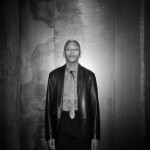







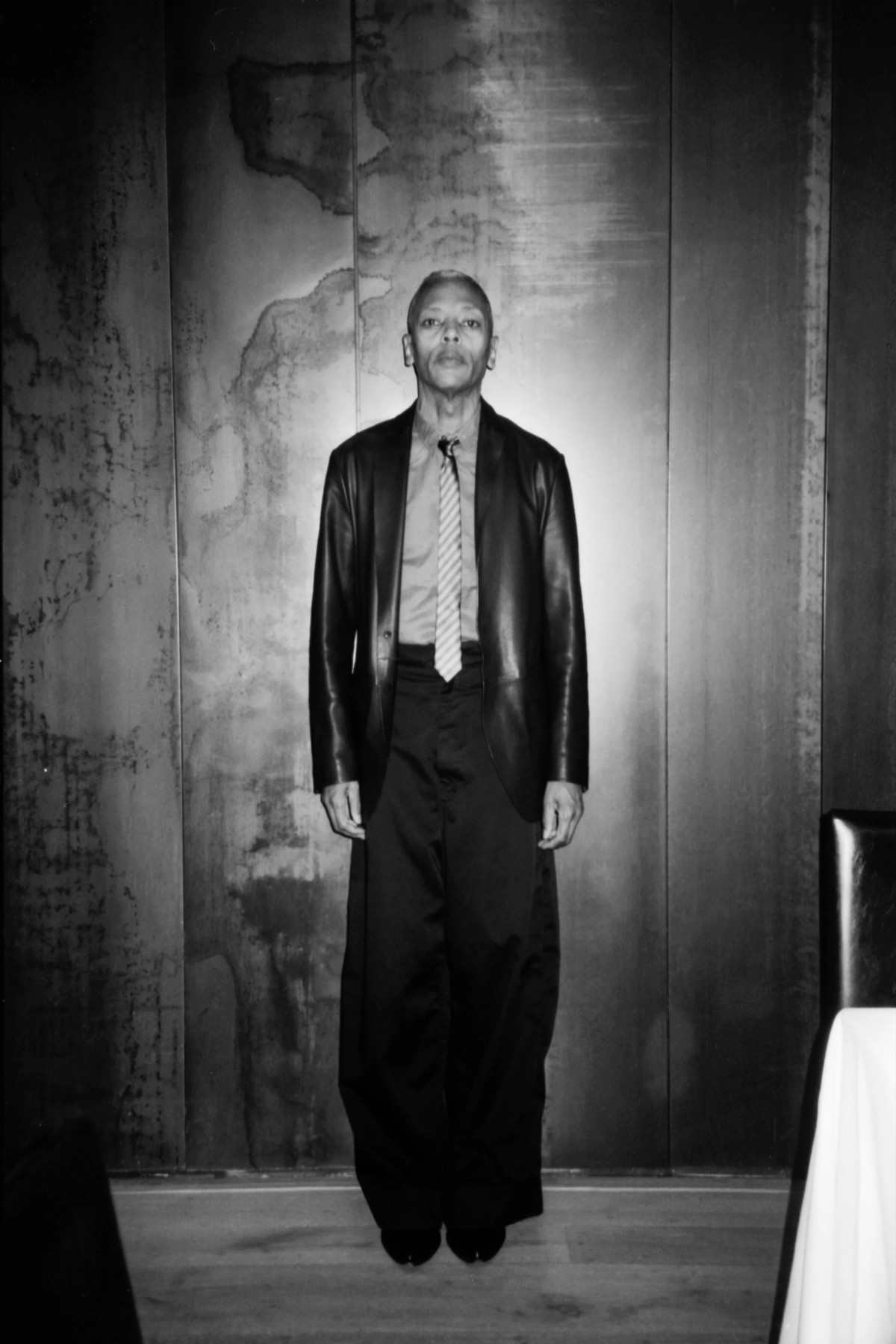
Jeff Mills is already seated at a table in the dining room of his hotel. He is wearing a black leather suit jacket and a tie. Shall we find somewhere quieter? he asks. A little apart from the breakfast crowd, we sit down at a freshly set table. We order tea and coffee. His voice is gentle, almost lost amid the low murmur of the breakfast room. I ask whether he reads poetry. Could you repeat the question? He has tinnitus and therefore has some difficulty hearing.
An hour later, as our conversation draws to a close, I want to know what significance silence has for him. What follows is a lengthy reflection on the importance of science. I do not ask any further questions and I thank him for the conversation.
JULIUS SEBASTIAN FÜHR: That’s a beautiful hotel you’re staying in.
JEFF MILLS: Oh yes, I have been staying here for many years, when playing in Amsterdam. So I know this hotel really well, but it recently changed its name and is now changing slightly.
JSF: Tell me, how do you choose a hotel? What matters most to you?
JM: I must say, the bed is the most important thing. And after all these years of traveling, this is the hotel that has by far the best mattress for DJs who are only here for one or two nights and really need to get some sleep. All DJs that I know swear by it.
JSF: After these decades of travel, one could say you’ve been on your own kind of techno odyssey, traveling from continent to continent. In Homer’s Odyssey, Odysseus encounters storytellers and singers along his journey. Has your own odyssey ever led you toward poetry at some point?
JM: Well, I spent some time reading Japanese poetry.
JSF: You mean haikus?
JM: Yeah, I got really intrigued by their structure.
JSF: The three unrhymed lines with a strict 5-7-5 syllable pattern.
JM: Exactly. With that in mind, I turned to electronic music, trying to interpret the structure and essence of poems into sound.
JSF: And were you able to do so?
JM: It worked. So when re-reading the same poem, the disjointed words and phrases reveal new angles, sparking new associations and allowing to discover and interpret different layers embedded in the poem. I remember that this kind of thinking led me to layering different tracks unsynced, in different harmonic/chord structures, to create a kind of fusion. So that each time you listen, your mind can meander from one part to another, focusing on different elements each time. And, similar to a poem, it reveals new layers and perspectives with every listen. In other words, every time you return to it, you develop new perceptions and associations. A good example of this way of working is Metropolis Metropolis, where I take unlikely fragments and piece them together, because I want the listener to have different ways of perceiving the work. The album The Clairvoyant is another example of this methodology.
JSF: Have you ever tried writing poetry yourself?
JM: For a hot moment there, but only trying.
JSF: Are you someone who gets emotional and cries listening to music?
JM: No, I think of music in a more practical way. And I remember that, as I was becoming a musician and artist, I tended to listen to music from an academic perspective. I was studying it.
JSF: Does that mean that, instead of being affected by music emotionally, you tend to analyze it, and could one say, that this reflects a kind of perfectionism? Are you a perfectionist?
JM: Very far from it. Making a perfect track is not even close to being an important point. The older I get, the more I realize that I just want to be able to understand someone’s music, and sometimes a person reveals themselves through the mistakes in their music. You see, I don’t want perfectly packaged creativity. I want music with the strings hanging out and untied. I want it rough so that I can understand the process. I want to hear the unfinished version of a finished song in order to understand how it got to that seemingly polished point. I want to hear the multitracks. I want to hear the individual stems. I simply want to hear everything.
JSF: What about your own music?
JM: I don’t want to make perfect music. I want to capture the moment, whatever is happening in that moment, whether it’s mistakes, glitches, or other mishaps. They are all equally important, and they help us understand music on a much deeper level. Also, when working, I never really took computer software and sequencing seriously. I tried, but I didn’t like it. It was too precise, so I went back to a very rough, analog way of recording music.
JSF: So, I assume that AI won’t play a role in your music any time soon.
JM: No, I’m pretty comfortable with the very tribal and simple way that I make music. All I need is for the machines to do a little bit, and then I’ll take care of the rest. They play these sequences, and then I’ll put them into the final mix. But actually, editing is what I use most, and it’s what I love most. I’m obsessed with editing. I think this came from working in radio. I would spend hours and hours editing just for fun, just to see how I could make something that seemed impossible possible through editing.
JSF: Do you mind people calling you and your work Afrofuturist?
JM: I’d say I’m even more confused. I don’t really know what Afro is supposed to mean. Aren’t we all from Africa? We are all the same. So a term like Afro doesn’t really make sense to me. Meanwhile, futurist carries a bit more weight, since we all live toward the future. But when we start dividing and sectioning things into Afrofuturist and futurist, it becomes too selective and discriminatory. And what is black, anyway? Again, we all come from Africa. The facts are the facts.
JSF: Well, are you a futurist?
JM: No, I’m just an average citizen working toward the ability to wake up the next day and be productive, just like everyone else. It’s a nice term, but I don’t really know what it’s supposed to mean.
JSF: Robert Hood once described people in techno as solitary people. Especially when you produce music, you’re alone in the studio, listening to the music by yourself. You once described it as a one-man spaceship. Are DJs lonely?
JM: I suppose I used to think this profession was solitary at first glance. But if you look at what our profession really is, it’s about considering people in every possible way. So today I would say it’s quite the opposite of lonely. As someone who produces music for people, I have to be around them and study them, they are my subject. And of course, I need to feel comfortable around them in order to be able to do what I do. Actually, I prefer being with people rather than being by myself.
JSF: You and Robert Hood used to call each other ten times a day, showing each other your work over the phone and giving advice, because nobody else understood what you were doing.
JM: Yeah, once a track was finished, we would literally call each other ten times a day, even though we were both recording in two different cities, and say, Listen to this! Then the other would call back, and this back-and-forth would go on for hours. A few really notable albums were created as a result of that, such as Minimal Nation from 1994. And it wasn’t so much about the sound itself, but about the progression of progress that was being made with each call. Each call was one step forward. And we really had to trust each other’s judgment in order to be able to continue something like that for hours.
JSF: What was being discussed during the making of Minimal Nation?
JM: You know, we were discussing the subject of minimalism in detail. At the time, I was researching and looking into minimal art. I remember that the Art Institute of Chicago had a large collection of minimalist works, as well as an exhibition, where I bought a whole bunch of books. I became really interested in the subject. I was explaining to Robert how we might transfer the concepts of minimal art into the realm of sound. It definitely made sense in relation to what was happening in techno music at the time. So some tracks were more linear, which meant that when you mixed them together, it wasn’t too much. A very skilled DJ could mix four of these tracks together and have more control, ultimately becoming more creative with the final output. The idea wasn’t to rely on a single track, but on four. The intention was never simply to play a track from beginning to end. The original intention was to mix them together and create something of your own. It was a do-it-yourself type of approach to electronic music. I mean, it didn’t quite end up that way. People began developing these very minimal tracks, which is okay. But the original intention was to think more in terms of a multitrack.
JSF: And do you still have that kind of exchange with someone today? Who do you call when you’re working on a new album?
JM: I’m a bit past that.
JSF: Is fear essential to making music, perhaps even where it begins for some?
JM: I wouldn’t say fear, maybe concern. But of course, it can be different for everyone. Concern seems to be the root issue in most of the collaborations I’ve done with other people. For instance, Underground Resistance was based on concern, concern about the lack of artistic freedom at the time and within the industry, especially the way it was structured. Artists never really had a chance to practice their art freely without having to tie it to major labels, licensing agreements, and artist deals. All of this felt like a form of slavery: if you signed your name, you often got nothing, or very little. Minimal techno, again, came from concern, the concern that music was heading in a direction where it wasn’t really about music anymore. And so this goes back to the idea of the artist playing a bigger role in the production and presentation, giving control back to the artist and not to the machines. So concern is typically present in almost every album. It starts with almost every album, from The Clairvoyant, Mind Power Mind Control, to Waveform Transmission, and almost everything.
JSF: Your new album, The Trip to Vega, is also rooted in concern. In the accompanying text, you describe a human exodus from Earth in 2097. What led you to choose that particular year?
JM: Whenever I pinpoint a date in the future, there’s usually some calculation based on the past. What I wanted to do was create a foreseeable date for the youngest demographic of people who probably listen to techno music, so 18- or 19-year-olds. A date they could realistically live to see, assuming they live a healthy life.
Putting that aside, my rather unorthodox calculation suggests that around that time, maybe not exactly, but somewhere near it, this planet will likely experience something catastrophic, either man-made or natural. Something significant enough to raise the question of whether we should leave the planet or try to create something that might prevent such an outcome. For example, a meteorite striking the Earth, or a solar burst knocking out all electricity and plunging everything into darkness. I suspect that by that time, something like that may well happen. So this album places that idea in front of people who would be old enough to potentially live to see that moment.
JSF: And how can I imagine the translation of this prophecy into a musical piece? Were you trying to create a chronological order or a dramaturgy that follows the narrative of the text, or did you try to capture the apocalyptic atmosphere of such an event and translate it into sound?
JM: I wanted to create an album that is the consequence of what has happened on this planet. There is no way to change what has happened, it’s too late. So the objective of this album is to reach the star system of Vega. It is a one-directional, never-to-return voyage, which is why it is uncompromising. I don’t need to make the listener feel comfortable, nor do I have to be nice to the listener.
This album has a different sound than anything I’ve done before. For one, I didn’t use a 909 on any of the tracks because it is a very familiar sound. Instead, I used a kind of manufactured version of an 808, with a very thick, full, and dense low end throughout the album. But also because it is an enormous task and an extreme situation, it has to feel enormous.
JSF: In the narrative, there is also a frequency coming from colliding tectonic plates that are constantly shifting, triggering a loss of human senses. It’s not just about leaving the planet, but also about the influence of frequency and sound on the human being, going as far as forcing us to leave the planet due to this sensory loss triggered by these frequencies.
JM: The senses we’ve discovered so far are quite fragile and sensitive. I chose a topic that is generally overlooked: hearing. Like many older DJs, I have tinnitus, so the idea of experiencing complete silence is over for me. This adjustment led me to investigate more deeply artists who also suffered from hearing impairment or tinnitus, for instance Van Gogh, whose condition must have been so extreme that he cut off his ear, or Beethoven, who gradually became deaf. Again, it shows the sensitivity of our senses.
In this album concept, I wanted to focus on a subject that is familiar to me: sound. I combined these ideas with the fragile human condition, the notion that we all live on a very thin line, and as soon as that line falls out of balance, it can have enormous effects on societies. And it’s not only about physicality. We might still be physically healthy, but mentally we could fall into a complete, irreversible chaos. Which is why I wanted to narrow it down and amplify this subject, as it sometimes seems a bit overlooked.
JSF: What is the human condition?
JM: Well, we’re on this planet that is constantly moving and evolving, and it’s important to remember that we, as humans, exist between the coldness of space and a wild celestial body that we cannot predict or control. So we exist between those two states. Human existence is a fragile circumstance, and we should appreciate our luck in even living up to a hundred years. But today, we are in a very hostile environment in space.
JSF: Are you interested in extending your life?
JM: If you mean physically, with all the advancement of technology, being able to detect and foresee in precautionary ways diseases and basically death, then it will definitely impact the life span of a human, and I believe turning 150 years is likely to happen soon. My wife is Asian, and Asian women are a very numerous group of humans. There are more Asian women than any other group of people, and they’re going to outlive everyone else due to their physical resilience. But also their diet is very healthy, my wife reminds me all the time when I’m eating junk food.
But apart from physical longevity, I think the mental aspect is much more exciting: taking all your thoughts, the way you do things, the way you speak, the way you react, more or less your character, and preserving your soul has more possibilities, and you might be able to take this and put it into a physical form.
JSF: If you were to live to experience the year 2097, would you stay on Earth or leave for Vega?
JM: I would like to leave, if that’s even possible. We don’t know what the world situation would be like, but it’s highly likely that most people won’t be able to leave. With this realization, you begin to accept that you might not be able to escape physically, but again, mentally you can, by thinking about existing in some kind of parallel existence. For instance, like Sun Ra, who believed he was from Saturn. You can reshape your mind and base your rationality on something far away from here, and then you can connect with a place far away. If we could master the mental, maybe there is a chance for those who aren’t able to leave physically to escape mentally.
JSF: Are you a nostalgic person?
JM: No, I’m not. I’m more excited about seeing something new, or something I’ve never seen before. I’m obsessed with that. I’m not very interested in the currency of history.